Introduction
As part of my ongoing technical design work, I've been building a modular ability system in Unreal Engine, combining C++ and Blueprints into a scalable, data-driven framework. It's both a practical tool for gameplay prototyping and an exercise in treating personal development with the same structure and planning I'd apply in a studio.
In this breakdown, I'll walk through the process from concept and system design to implementation and iteration.
Why build a modular ability system?
Simple attacks, healing spells, dashes, buffs: abilities are fundamental to countless genres. As a technical designer, I'm less interested in building individual abilities than in creating a system that lets designers define abilities easily, tweak parameters, and add new types without changing core code.
My design goals:
- Data-drivenNew abilities come from data assets, not hardcoded logic.
- ModularExecution logic is extensible without refactoring.
- Designer-friendlyBlueprint-accessible and readable, even for non-programmers.
- MaintainableFuture features like combos or upgrades integrate naturally.
Conceptualizing the system
The first challenge was scope. Rather than a complex RPG ability editor, I focused on a small, functional prototype that solved one clear problem:
"How can I let designers define new abilities without touching code, while keeping the system scalable for different effect types?"
I planned the system around:
- Ability Data Assets as modular definitions
- An Ability Component for executing effects and managing cooldowns
- A simple UI widget for cooldown visualization
- Event dispatchers so Blueprint designers can hook into ability execution
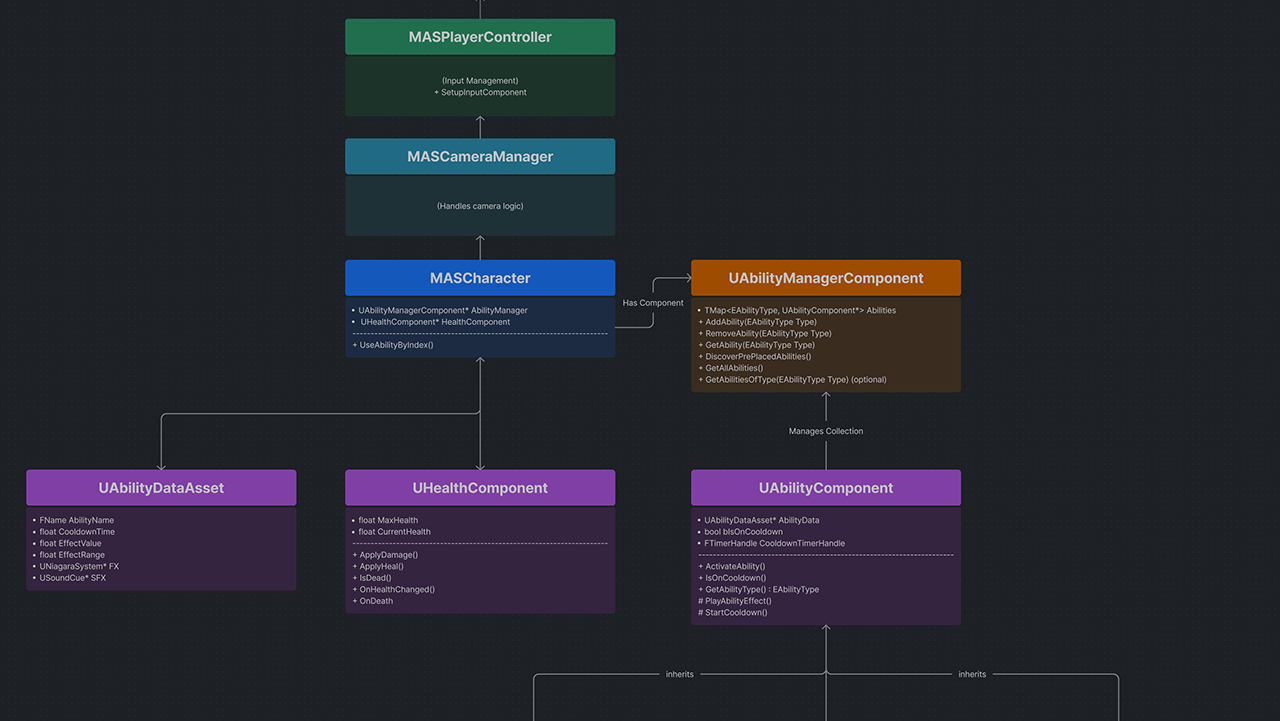
Before writing code, I mapped the structure with UML diagrams and rough data-flow sketches to clarify each class's responsibilities and plan for future extensibility.
System structure
At a high level, the system has three main pieces:
UAbilityDataAsset
A simple Unreal Data Asset that stores:
- Ability name
- Cooldown time
- Effect type (Damage, Heal, Dash, etc.)
- Effect value
- FX and SFX references
UAbilityComponent
An Actor Component that:
- Loads and manages abilities assigned in the editor
- Handles input-based activation
- Tracks and enforces cooldowns
- Executes effects using data from Ability Data Assets
WBP_AbilityCooldownDisplay
A basic UI element that shows each ability's cooldown in real time, driven by event dispatchers from the Ability Component.
Separating data from execution draws a clear line between what an ability is and how it behaves.
Planning before coding
Before opening Unreal, I treated the project like a real development sprint:
- Created Jira tasks and epics to manage priorities and time estimates
- Wrote Confluence-style documentation for both designers and engineers
- Defined stretch goals (combo chaining, upgrades) for future sprints
- Focused early code on scalability and readability, not feature creep
This kept the implementation tightly scoped and avoided "prototype sprawl."